Centralized Payment Processing with SAP Advanced Payment Management


How can custom payment formats be processed centrally within SAP?
Historically, SAP had limitations in this area. SAP Advanced Payment Management (APM) addresses them through an XML framework that handles complex payment formats centrally. This article explains how the framework works and what it means for treasury operations.
SAP Bank Communication Management (BCM) has been SAP’s solution for integrating a corporate’s SAP system with their banks. It is offering a seamless and secure connection to either a payment network or directly to the bank’s host-to-host solution. Payment and collection files generated from the Payment Medium Workbench can be transferred directly to the external systems, and status messages and bank statements can be received and processed into the SAP application.
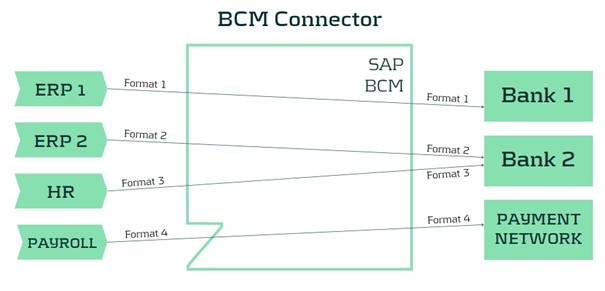
The BCM solution has proven to be successful, and corporates wanted to leverage the solution also for transferring messages that do not have their origin in the SAP itself. For example, payment files coming from an HR system or from a legacy ERP system need to be transferred via the same connection that has been established with the BCM setup. For this requirement, SAP introduced the SAP Bank Communication Management option for multisystem payment consolidation, more commonly referred to as the BCM Connector. This add-on made it possible to process payment files generated in external modules or systems into SAP BCM.
However, the BCM Connector has an important limitation: it can only forward the exact format received to external parties. This means that if a legacy system provides a payment file in a proprietary format, it cannot be converted to a more commonly accepted (e.g., XML) format. As a result, compliance with bank requirements regarding payment formats lies with the originating application, limiting the ability to manage payment formats centrally from within the SAP system.
To address this limitation, SAP developed Advanced Payment Management (APM), a module for organizations that need centralized payment processing. APM supports several scenarios for managing payments and payment formats in a centralized environment. It is available for SAP S/4HANA on-premise, private cloud, and as an SAP S/4HANA Cloud solution. For a broader overview of APM functionality, read our article on SAP Advanced Payment Management.
One of the main features of the APM solution is the file handling, which is implemented through an XML Framework. In short, this means that all payment files that need to be processed are handled as an XML message in a canonical data model. This allows for standardized payment processing across various incoming formats.
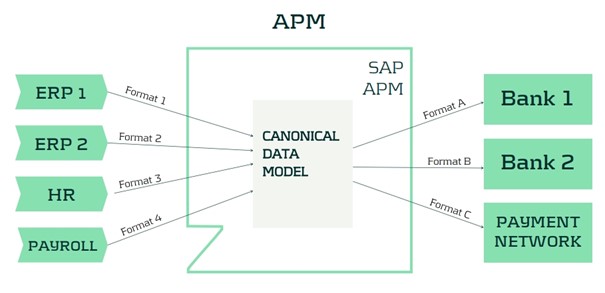
The main advantages of the XML framework are:
- Parsing into easy formats
- Complex message structures are mapped into generic XML structures that are aligned to the most used message standards (ISO20022). These structures also match to a large extent to the internal data structure of the business objects within SAP APM.
- Embedded XML schema validation
- The XSD schema files for the input structures can be loaded into APM to be used for validation of incoming messages. This takes away the burden of defining and implementing custom-built validations for these files.
- Interface for easy implementation
- Transferring the data elements from the incoming messages into the canonical data structures can be achieved via predefined BAdIs and using several easy-to-use methods for retrieving and analyzing the source message.
- Parallel processing for large messages
- The XML Framework offers functionality to divide large messages into smaller building blocks and process them in parallel. This makes APM a very powerful solution that is able to process large numbers of payments in a timely manner.
- The XML Framework offers functionality to divide large messages into smaller building blocks and process them in parallel. This makes APM a very powerful solution that is able to process large numbers of payments in a timely manner.
The solution can also be used for non-XML messages. This requires a preprocessing step where the source file is converted to an XML representation of the file. After this step, the message can be processed like any other XML file including the validation and parallel processing options.
Implementing this solution for XML and non-XML formats is a technical exercise that requires ABAP skills and knowledge of the SAP enhancement framework. However, SAP has made it easier to implement custom formats with the framework while fully utilizing the capabilities of the APM module.
Centralizing payments in APM also makes it possible to apply centralized fraud and sanction screening. SAP Business Integrity Screening complements the APM payment engine and helps with fraud prevention. Read how both work together in our article on preventing payment fraud with SAP APM and Business Integrity Screening.
For organizations seeking to enhance their payment processing capabilities through centralized management and solutions like SAP Advanced Payment Management, our team is equipped to provide expert guidance. To explore how APM can support your treasury operations and ensure seamless financial integration, please reach out to us at [email protected].
-
The Tokenisation of Corporate Treasury

-
Real-Time Cash Management and Accounting: Moving from Next-Day Statements to Intraday Cash Visibility

-
From SAP BTP to SAP Business AI Platform: What it means for Treasury

-
Agentic AI in SAP Treasury and Working Capital: What SAP Can Do Today and What Comes Next

-
Bank Consolidation: Are Treasurers Right to Worry?

-
Key SAP Treasury and Cash Management Updates

-
SAP Analytics Cloud for Treasury Liquidity Planning

-
Preventing Payment Fraud with SAP Advanced Payment Management and Business Integrity Screening

-
SAP S/4HANA Treasury Business Partner Design and Maintenance

-
The Digital Agenda Has Increased the Cybercrime and Fraud Threat Landscape – It’s Now Critical for Corporate Treasury to Build Resilience