Real-Time Cash Management and Accounting: Moving from Next-Day Statements to Intraday Cash Visibility



How a bank API push strategy with SAP S/4HANA and Advanced Payment Management puts idle cash to work, and what corporates should consider before starting.
For many corporates, treasury still starts the day with yesterday's data. Bank statements arrive overnight, accounting processes them in the morning, and large incoming payments are often noticed only when someone checks the e-banking portal. Meanwhile, incoming money waits for hours on a low-interest account when it could already be earning more.
Real-time treasury closes this gap. By connecting banks directly through APIs and feeding intraday data into SAP S/4HANA, treasury and accounting work with the same up-to-date information. This article follows the journey from opportunity to business case: why closing the one-day gap is worth it, the approach of having banks push intraday data to you, the target architecture based on a passive API push, the operating model that makes it work, the outcome in cash put to work, a practical delivery roadmap, the numbers behind the investment, and what to consider before starting.
1. The problem: a day behind reality
Without real-time connectivity, treasury and accounting face three connected issues:
- Cash management: there is no real-time overview of bank balances, incoming payments are known only the next day, and manual e-banking checks are needed to identify large receipts.
- Accounting: end-of-day statements are pulled from the banks the following morning, creating a heavy workload peak at the start of each day.
- Financial impact: funds received during the day stay on low-interest accounts until the statement arrives. In the reference case behind this article, an average of €250m across all accounts could not be used efficiently.
The solution is to make bank data available in real time.
2. The approach: real-time data from the bank
The goal is to remove the one-day delay between what happens in the bank and what treasury and accounting see. Instead of waiting for end-of-day statements, banks tell treasury immediately when money moves, so that balances and incoming payments are visible during the day.
The approach has three steps:
- Connect banks in real time: banks send intraday information through APIs, instead of treasury collecting it the next morning.
- Update treasury and accounting automatically: balances and transactions flow into SAP without manual e-banking checks or a morning workload peak.
- Put idle cash to work: with an accurate intraday view, funds received during the day can be invested overnight instead of sitting on low-interest accounts.
There are two ways to get intraday data: pulling (treasury asks the bank regularly) or pushing (the bank notifies treasury when something happens). We recommend pushing because it is simpler, requires less communication between SAP Business Technology Platform (BTP) and the bank APIs, and relies on standard SAP tools.
3. Target architecture: how the approach is built
To deliver this, banks push notifications to SAP BTP, which normalizes the data and hands it to S/4HANA, where SAP Advanced Payment Management (APM) manages inbound and outbound processing.
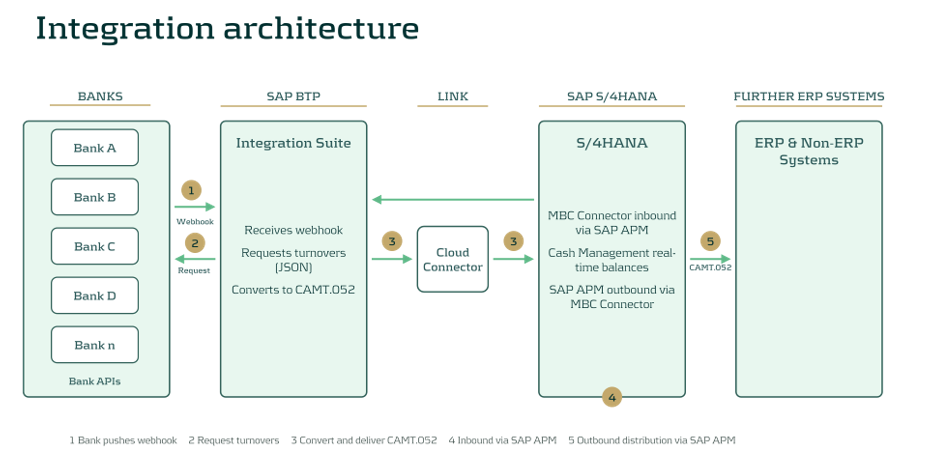
The data flow runs in five steps:
- Bank notification: the bank sends a webhook call to SAP BTP Integration Suite to signal a new account turnover.
- Account selection: throughout the day, whenever new account turnover occurs, the bank sends real-time notifications that allow SAP BTP Integration Suite to dynamically identify the relevant bank account directly from the notification payload and retrieve the corresponding intraday statement (CAMT.052) via the Bank API. At the end of each business day, the relevant active bank accounts eligible for daily reconciliation are determined, after which Integration Suite invokes the Bank API to retrieve the final end-of-day statements (CAMT.053, the ISO 20022 end-of-day statement format) to reconcile all intraday turnovers and confirm opening and closing balances.
- Request and normalize: Integration Suite requests the turnover data from the bank API. Data returned as JSON is converted into a standard CAMT.052 message, the ISO 20022 intraday statement format, and delivered to S/4HANA.
- Inbound processing: the Multibank Connectivity (MBC) Connector in S/4HANA receives the CAMT.052 messages, and SAP APM runs the import with its standard inbound processing applications. This updates both Cash Management and Accounting modules.
- Outbound processing and distribution: for entities running their accounting operations on other SAP or non-SAP systems, APM distributes the statement data via the MBC Connector on a real-time basis, supporting open-item clearing and triggering dependent processes in sales and delivery in a straight-through process.
4. Operating model impact: from morning peaks to a steady flow
The technology is only part of the change. A real-time treasury also changes how the function operates:
- Governance and strategy: treasury policy is updated for real-time decision-making.
- Organization and people: the team moves from repetitive data gathering and processing to exception management.
- Process: continuous reconciliation of memo records in cash management and clearing of open items in accounting replaces batch cycles and workload peaks in the morning by smoothed operations throughout the day and real-time operations.
- Technology and data: API integration platforms consolidate all bank account cash flows in a single treasury system enabling full cash visibility in cash management and feeding all accounting systems in the group with real-time data.
- Performance and control: real-time KPI dashboards, notifications and alerts provide continuous visibility.
Additional benefits include faster, more accurate cash forecasts, standardized bank statement data through standard bank statement formats, and stronger compliance through automated, auditable data flows. The status of a payment request sent to a bank not just gets updated as accepted but also executed and confirmed in real time allowing the financial process to end with an updated bank balance and cleared open items within minutes rather than the next day. The integration architecture also serves as a reusable template for onboarding further banks.
5. Outcome: from idle cash to interest income
Real-time bank data changes three things at once:
- Cash management: balances update in real time and treasury manages cash in one central place, without manual e-banking checks.
- Accounting: intraday statements spread the workload over the full day, and near-real-time open-item clearing lets salespeople confirm customer payments within minutes, even on bank holidays.
- Liquidity: real-time balances, combined with real-time payments (not yet available in all countries), cut idle cash by more than 10%, and that cash earns overnight interest instead of sitting on a current account.
Money that used to wait a day for a statement now goes to work the same day, earning overnight interest instead of sitting on a current account.
6. Delivery roadmap: live in 24 weeks, saving every day after
For a new bank, delivery takes about 24 weeks while for an already integrated bank it takes around 14 weeks: discovery and design, build and configure, test and validate, and go-live and stabilization. Because the integration architecture is standardized, further banks and accounts can then be easily onboarded using the same approach. The implementation concludes with a handover to continuous real-time operations:
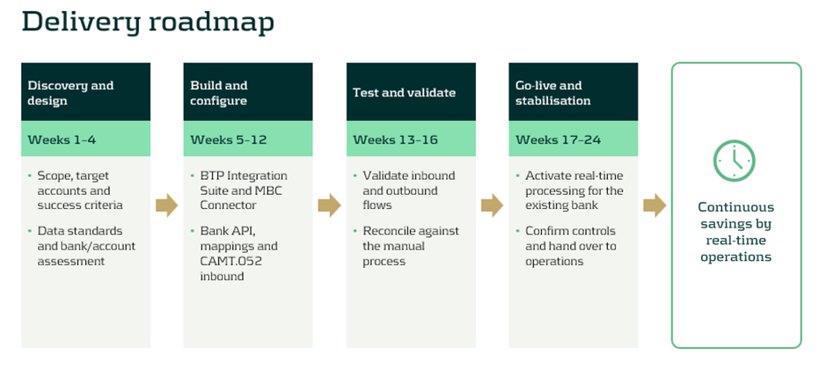
Following go-live and stabilization, treasury and accounting move into continuous real-time operations. Teams use intraday data for cash decisions, monitor processing and controls, and manage exceptions as part of day-to-day operations. End-of-day CAMT.053 statements remain in place to reconcile intraday turnovers and confirm daily opening and closing balances.
7. Business case: the numbers behind real-time treasury
For a company with €2 billion in annual sales revenue, real-time balances cut its idle cash by €25m on average; invested overnight at 200 basis points above the current-account rate, that alone adds €500k a year. With the other benefits, the annual impact is at least €725k (Table 1).
| Benefit | How it is calculated | Annual Savings |
|---|---|---|
| Automated balance checks | 2 h daily e-banking checks = 25% of a €60k full-time equivalent (FTE) | €15k |
| Real-time liquidity forecasting | No manual memo records across entities (4 similar roles) | €60k |
| One day less FX exposure | €25m x 1/5 one-day volatility × 6% annual volatility × 50% less exposure | €150k |
| Smarter overnight investment | €25m less idle cash × 2% (200 bp) extra interest | €500k |
| Bank fees | Lower statement fees offset API costs | ≈ €0 |
| Total | €725k+ |
The investment is modest: €100–200k one-off (about €100k and three months for a known bank and API, €200k and six months for a new one) plus about €65k a year for SAP BTP Integration Suite, with SAP APM and MBC Connector licences in place. Net of licensing, the case returns about €660k a year: payback in under twelve months.
Conclusion
Cash you cannot see is cash you cannot use. By replacing next-day statements with intraday data, treasury can identify available funds sooner, make more informed funding and investment decisions, manage currency risk more effectively and reduce manual work. Having banks push updates to SAP as events occur keeps the solution close to standard, which lowers complexity and long-term maintenance. The real value comes from clear responsibilities, updated processes and agreed decision-making rules, which turn real-time data into better decisions.
Zanders combines SAP treasury expertise with hands-on experience in bank API integration and SAP Advanced Payment Management. If you want to assess the business case for your bank landscape or plan a first implementation, we would be happy to assist you.
-
Weathering the SAP S/4HANA storm: A Zanders guide to making a successful shift to SAP’s new operating model

-
Citi & Zanders - Getting Started with GenAI in Treasury: Practitioners Guide

-
A spin-off for AkzoNobel’s treasury

-
A Treasury Technology Roadmap to S/4HANA

-
Kongsberg Automotive’s road map to a transformed treasury

-
How to transition to SAP S/4 HANA from your current Treasury Management Architecture

-
The Case for AI-Enhanced Testing in Treasury

-
Citi & Zanders - SAP S/4HANA Migration

-
Supporting Your Treasury Processes with SAP S/4HANA Prioritizing Cash and Banking


Ready to assess your cash visibility?
Talk to our experts