Agentic AI in SAP Treasury and Working Capital: What SAP Can Do Today and What Comes Next


How should corporate treasury and SAP product owners approach agentic AI in SAP Treasury? What is available now, what is planned, and what should be in place before AI agents are introduced and allowed to act on treasury data and processes? This article addresses these questions from a practical SAP Treasury perspective.
Key Findings
- Agentic AI is entering SAP Treasury. Treasury is part of SAP's Autonomous Finance vision for moving finance from transaction processing and periodic reporting to AI-driven, continuously optimized finance operations. Autonomous Finance is a key pillar of SAP's broader Autonomous Enterprise strategy. In treasury, SAP now presents agents covering cash positioning, bank relationships, treasury financing, cash forecasting, FX risk hedging and market data validation.
- The portfolio is growing. Additional treasury and working-capital capabilities continue to emerge as SAP develops its Autonomous Finance portfolio.
- The direction is from insight to action. Agents can analyze treasury data, identify risks and opportunities and recommend actions. The logical next step is increasing levels of controlled execution within predefined limits, policies and governance rules.
What this means in practice:
- The main challenge may not be AI itself. Decisions of an agent are only as reliable as the transactional data, master data, processes and controls behind them.
- Agents must be explainable and repeatable. The same data and the same policy should lead to the same decision, and every recommendation should be traceable.
- Agent autonomy requires boundaries. The important question is not whether an agent can execute, but whether the company is prepared to let it execute without human intervention.
1. Treasury as Part of SAP Autonomous Finance
SAP does not look at treasury in isolation. Treasury is one part of the broader Autonomous Finance direction, where assistants and agents monitor business processes, identify exceptions and opportunities, and help coordinate actions.
For treasury, this is important because treasury depends heavily on information coming from other finance processes. Receivables, payables, accounting and planning can all influence the cash position, liquidity forecast and resulting treasury decisions.
This makes treasury a logical point where multiple finance processes and agents can meet.
2. What SAP Offers in Treasury Today
Treasury automation is not new.
Most treasurers are familiar with batch jobs, interfaces, workflows, straight-through processing and RPA bots. However, these solutions typically follow predefined logic: if X happens, execute Y.
An AI agent works differently. It works toward an objective. It analyzes the situation, determines what is important and proposes or coordinates the next actions within given policies and limits.
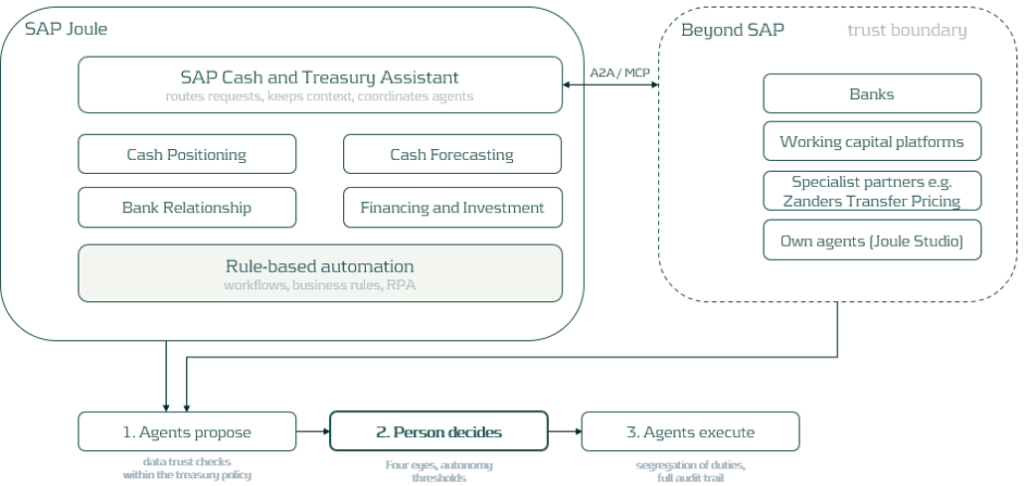
SAP is building this capability around the Cash and Treasury Assistant. SAP describes the assistant as orchestrating specialized agents, including:
- Cash and Treasury Orchestration Agent coordinates the specialized agents within the assistant;
- Cash Positioning Agent scans positions continuously to flag concentration risk, prevent overdrafts and surface idle cash;
- Cash Forecasting Agent projects liquidity by currency and entity across short- to long-term horizons;
- Bank Relationship Agent gives visibility across banking partners to optimize relationships, cut costs and manage risk;
- Treasury Financing Agent provides visibility and control over treasury financing positions and funding needs;
- FX Risk Hedging Agent supports time-consuming steps such as handling over-hedge situations;
- Market Data Validation Agent checks market data for availability and consistency before critical processing;
- Treasury Operations Agent monitors treasury processes end to end, detects exceptions and guides users through issue resolution.
Are these agents already in use? Yes, several agents are already available and can be used by SAP clients, while others are on the roadmap, and their scope changes with almost every release. So, it is worth checking the status of each agent before planning an implementation.
Consider a treasurer asking: "Do we have enough liquidity for the next five business days?"
A traditional TMS application provides balances and forecasts. An agent, or a combination of agents, can analyze the position, expected flows and potential shortfalls and bring the relevant situation to the treasurer's attention. The important difference is that the treasurer does not need to search through all available information to find what matters. The system increasingly moves from presenting information toward saying: "These situations require your attention now."
3. Beyond Standard Agents
With Joule Studio, organizations can build custom agents and connect them with business processes and data. SAP also supports two open standards that make agents easier to connect:
- Model Context Protocol (MCP) defines how an AI agent connects to tools and data sources, such as an SAP system, a bank portal or a market data provider. It is like a universal plug: once a system offers an MCP connection, any compatible agent can use it without custom integration.
- Agent2Agent (A2A) defines how agents from different vendors communicate with each other. For example, an SAP treasury agent could request a funding quote from a bank's agent.
In simple words, MCP connects agents to systems, and A2A connects agents to other agents. For treasury, this opens scenarios such as debt covenant monitoring, bank-fee analysis, intercompany funding or company-specific controls.
Existing RPA bots do not automatically become obsolete either. Rule-based automation can remain useful where predictable execution is required. However, the same principle applies here as in other SAP developments:
- Use SAP standard agents first where they meet the business requirement and fit the target architecture.
- Build a custom agent when a clear requirement cannot reasonably be covered by standard functionality.
- Keep business limits and policies configurable rather than hardcoding them into agent instructions.
Every additional agent and integration can bring value, but also introduces another component to govern and support.
It is also important to distinguish architecture direction from production availability. SAP's current architecture documentation notes that some interoperability components are still evolving, including full bidirectional connectivity with third-party and self-hosted agents through the Agent Gateway.
4. The Practitioner View
I have been working as an SAP Treasury consultant since 2009. From my experience, technology is not the hardest part. The harder question is whether we can trust an agent enough to let it act on treasury data. Four areas will be important: data, controls, explainability and change management.
4.1 Data Before Decisions
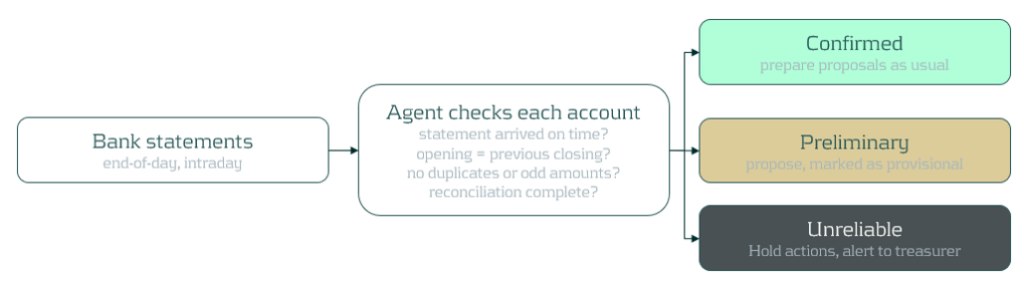
Treasury data is not always as clean, complete and timely as we would like. Bank statements can arrive late or in the wrong format. Reconciliation may remain open for hours. Sometimes a bank has to resend corrected statements. Until then, the cash position for the affected accounts is incomplete, regardless of what the system displays. A treasurer understands such a situation. An agent needs an explicit mechanism to recognize it too. I call this a Data Trust Gate. Before a financially material action, such as a funds transfer, the agent should validate statement completeness, balance consistency, reconciliation status and processing exceptions.
Each account can then receive a status:
- Confirmed: proceed according to policy.
- Preliminary: create a provisional recommendation.
- Unreliable: stop and escalate.
SAP already applies a related validation principle to market data with the Market Data Validation Agent. Bank and transactional data deserve the same discipline. An agent that acts quickly on wrong data is worse than no agent at all.
4.2 Controls Apply to Agents Too
Controls do not disappear when an agent takes over activities previously performed by a person. They become even more important. Several existing treasury controls should therefore also be considered for agent-driven processes:
- Segregation of duties. Agent identities and permissions should be clearly defined and included in regular authorization reviews. The agent that prepares a payment should not also control its approval.
- Deal release and payment approval. Agent-created transactions should still follow the appropriate release and payment-control processes.
- Thresholds and four-eyes principle. Define what an agent may do based on amount, counterparty, account and transaction type. Within an approved boundary it may eventually execute; outside it, it should propose and escalate.
- Audit trail. For every material action, it should be possible to understand what the agent did, why, which data and policy were used, which approvals applied and which agent version acted.
Autonomy should increase only where the financial impact is understood, the underlying data can be trusted and the action remains sufficiently controlled and auditable.
4.3 Explainability and Repeatability
Treasury decisions affect real cash, funding costs and financial risk. Therefore, treasury should understand why an agent proposed an action, which data it used and which assumptions influenced the recommendation. A recommendation that cannot be explained is difficult to challenge, approve and audit. This becomes more important as organizations move from recommendations toward execution.
Repeatability is equally important. AI models are not fully deterministic: the same question asked a few times can produce answers that differ in detail. For treasury, it is crucial that the same data and the same policy should lead to the same decisions. This can be achieved by leaving calculations, limit checks and postings to the rule-based functions, while the agents analyze, prioritize and propose. The inputs, outputs and agent version should be logged, so every result can be traced and reproduced.
4.4 Change Management Becomes Continuous
SAP projects traditionally follow a familiar cycle: configure → test → approve → go live.
Agents introduce another dimension. Their behavior can change when models, instructions, policies, tools or integrations change. An agent should therefore be treated as a controlled application. Material changes may require regression testing, permission review and re-approval. The agent validated six months ago may not behave exactly like the one running today.
5. Where I Would Start
If I started an agentic treasury project today, my first step would involve no AI. I would first assess the existing treasury landscape:
- SAP Treasury system;
- bank connectivity and interfaces;
- treasury business processes around the technology;
- history of system and process incidents;
- data quality;
- SAP roles and segregation-of-duties setup.
This creates a baseline for deciding where an agent can safely provide value. I would then start with lower-risk use cases and standard SAP capabilities where possible, initially keeping humans at the decision point. Only after establishing reliable data, processes and controls would I move toward higher levels of process automation and autonomy.
Conclusion
SAP is already building agentic treasury as part of its Autonomous Finance direction through the Cash and Treasury Assistant, specialized agents and Joule Studio. But the foundations of good treasury do not change: reliable data, standardized treasury processes where possible, strong controls and clear accountability.
For treasury professionals this creates a new responsibility. We will increasingly design not only processes, but also the boundaries within which intelligent agents are allowed to operate. The future treasury organization may not be the one with the most autonomous AI. It may be the one that knows exactly where autonomy creates value and where human judgment must remain in control.
At Zanders, we combine treasury expertise with treasury technology and AI capabilities. We can support organizations in assessing the readiness of their existing treasury landscape, defining how agents should operate and interact with treasury processes and systems, and developing a practical strategy for implementation, governance and ongoing support.
If you are considering agentic AI in SAP Treasury, we would be happy to help assess your current landscape, identify the right use cases and define a realistic path from today's automation toward controlled agentic processes.
Sources:
https://www.sap.com/use-cases/joule-assistant/cash-treasury-ai
https://architecture.learning.sap.com/docs/ref-arch/ae6821
https://www.sap.com/topics/events/sapphire/innovation-news-guide-2026
-
Weathering the SAP S/4HANA storm: A Zanders guide to making a successful shift to SAP’s new operating model

-
Citi & Zanders - Getting Started with GenAI in Treasury: Practitioners Guide

-
A spin-off for AkzoNobel’s treasury

-
A Treasury Technology Roadmap to S/4HANA

-
Kongsberg Automotive’s road map to a transformed treasury

-
How to transition to SAP S/4 HANA from your current Treasury Management Architecture

-
The Case for AI-Enhanced Testing in Treasury

-
Citi & Zanders - SAP S/4HANA Migration

-
Supporting Your Treasury Processes with SAP S/4HANA Prioritizing Cash and Banking


Ready to think about Agentic AI in SAP Treasury?
Talk to our experts