Financial Guarantees in Intragroup Arrangements: A Growing Focus for Tax Authorities



A parent guaranteeing a subsidiary’s loan is routine treasury practice, but recent rulings show it can carry real transfer pricing exposure.
Intragroup financial guarantees are receiving growing attention from tax authorities worldwide. What looks like routine treasury support, such as a parent guaranteeing a subsidiary's external loan, can give rise to material transfer pricing exposure where it is not priced on an arm's length basis. Where a guarantee improves the borrower's creditworthiness, and allow the borrower obtaining better financing conditions, tax authorities may reasonably expect the guarantor to receive an arm's length fee.
Why financial guarantees matter
A financial guarantee can allow a group entity to access external financing it could not secure on its own, borrow a larger amount, obtain a lower interest rate, or meet a lender's conditions. This is precisely why guarantees are so valuable from a business perspective for multinational groups.
The transfer pricing question becomes how much of it the borrower should pay for, and, specifically, whether the guarantee provides value beyond the implicit support the borrower already receives simply by belonging to a multinational group. That distinction is central to every guarantee fee analysis, and it is the point on which most disputes with tax authorities turn.
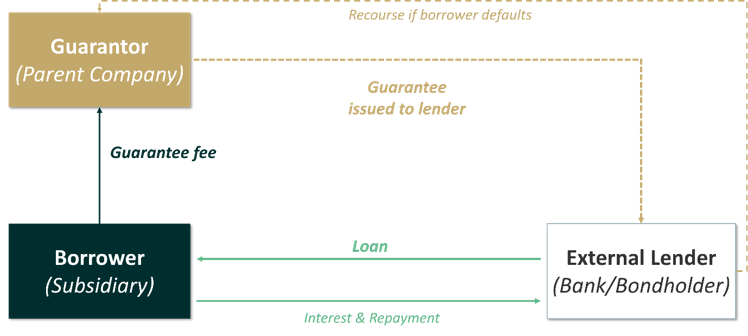
The parties are most often a parent and subsidiary, as shown in Figure 1, though the same structure applies equally to guarantees between fellow subsidiaries or other related group entities. Figure 1 summarizes this structure: the parent's guarantee runs to the lender, the financing runs to the subsidiary, and a guaranteed fee flows back to the parent in exchange for the risk it has assumed.
What the OECD guidance says
Guidance on pricing financial guarantees was first issued by the OECD in February 2020 and later incorporated as Chapter X of the 2022 edition of the OECD Transfer Pricing Guidelines. Its starting point is that every arrangement must be accurately delineated based on its contractual terms and the economic consequences for each party. The OECD defines a guarantee as a legally binding commitment by the guarantor to assume a specified obligation if the borrower defaults, thereby excluding lesser forms of credit support, such as letters of comfort, which involve no binding assumption of risk.
Chapter X is emphatic on one point above all: implicit support must be factored into the borrower's credit rating before any guarantee's benefit is assessed. In practice, this means an explicit guarantee will not necessarily confer any benefit where the borrower is not benefiting beyond the credit enhancement already attributable to implicit group support.
Chapter X recognizes several methods for pricing financial guarantees, including the CUP method, the yield approach, cost-based approaches, expected-loss valuation and capital-support methods. In practice, external CUPs are often difficult to identify due to differences in creditworthiness, guarantee scope and tenor, while the yield approach measures the borrower’s interest-rate benefit after considering implicit support and the effect of the explicit guarantee. Cost-based, expected-loss and capital-support approaches instead focus more on the guarantor’s risk, expected losses and required return on capital. The OECD does not prescribe a single mandatory methodology; the appropriate method depends on the facts and circumstances and the availability and reliability of the underlying data.
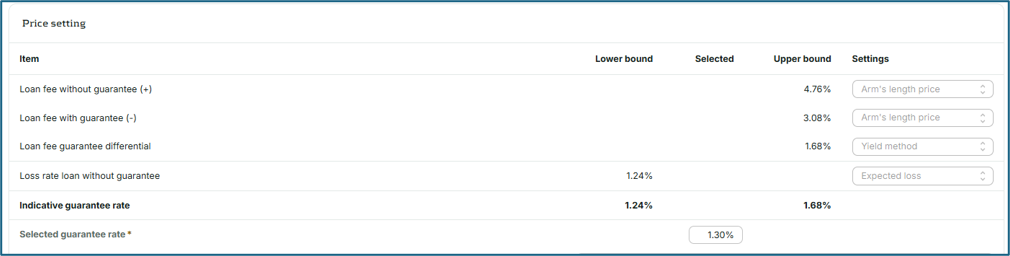
The Zanders Transfer Pricing Suite applies both the yield approach and the expected-loss method, in line with commonly accepted guarantee-pricing practices, providing users with greater transparency and flexibility when assessing an arm’s-length guarantee fee.
Why tax authorities are watching closely
Guarantee fees remain a recurring flashpoint, and recent developments have set a direction for how tax authorities evaluate these arrangements. In the Netherlands, for example, the Dutch Ministry of Finance published its Notitie Garantiefees in May 2025, a policy note from the Coordination Group on Transfer Pricing (CGVP) setting out how tax authorities should assess the tax treatment of intragroup guarantee fees. It sets out a step-by-step approach to pricing, endorses the yield method also favored by the OECD, and stresses that correctly determining each party's creditworthiness, including the effect of implicit support, is the foundation on which the rest of the analysis rests.
Months later, in September 2025, the Amsterdam Court of Appeal ruled on the matter in Case No. ECLI:NL:GHAMS:2025:2377. The dispute concerned, among other intragroup charges, guarantee fees paid by a Dutch entity to its parent for guarantees on listed bonds. The Court ruled in favor of the tax authorities, applying credit-rating criteria to find that the borrower qualified as a "core" member of the group for rating purposes. On that basis, implicit group support alone already produced a stand-alone credit rating equivalent to the rating achieved with the explicit guarantee in place, meaning the borrower would have obtained the same terms whether or not the guarantee existed. Because the guarantee therefore added no incremental benefit, the fee failed the arm's length standard.
In its reasoning, the Court also cited Canada v. General Electric Capital Canada Inc. (2010 FCA 344), one of the most cited guarantee fee precedents internationally. That case concerned a 1% annual fee paid by GE Capital Canada to its AAA-rated US parent for a guarantee over third-party loans. The Canadian tax authority argued that implicit support already placed GE Canada's creditworthiness on par with its parent, so the guarantee conferred no additional value, and the fee was not deductible. The Tax Court of Canada applied a yield-based approach, comparing the borrowing cost GE Canada would have achieved standalone, including the implicit group support, against the cost achieved with the guarantee in place, and found the resulting interest rate differential exceeded the 1% fee, confirming it was arm's length.
Luxembourg provides a further illustration. In March 2026, the Luxembourg Administrative Tribunal issued a ruling on intragroup financing and guarantee arrangements (ECLI:LU:TADM:2026:48905). The case emerged after Belgian tax authorities spontaneously disclosed to their Luxembourg counterparts that a Luxembourg holding company had issued an undisclosed counter-guarantee assuming the credit risk on a related Belgian company's branch financing activity. The Tribunal agreed that an independent party would not assume credit risk without compensation, but it rejected the tax administration's attempt to reallocate the branch's financing income to the Luxembourg guarantor, limiting the adjustment to an arm's length guarantee fee. The Tribunal did not itself calculate that fee and instead remitted the case to the Luxembourg tax authority to determine it.
Although with a different focus, more recently, in May 2026, the Italian Supreme Court (Corte di Cassazione, Case No. 13136/2026) dismissed a challenge brought by the Italian tax authority in a case involving an Italian subsidiary that had provided mortgage and pledge guarantees to a pool of US banks for the benefit of its US parent, without charging any fee. Rather than focusing on pricing methodology, the Court relied on the domestic doctrine of “compensatory advantages” (vantaggi compensativi) to hold that there was sufficient commercial justification for the guarantees even in the absence of any fee. Although the facts differ, the case illustrates how intragroup financial guarantees, remain under the scrutiny of tax authorities in different jurisdictions.
Taken together, these developments show tax authorities worldwide sharpening their scrutiny of intragroup financial guarantees, with particular focus on whether the pricing is arm's length, whether a proper creditworthiness assessment has been conducted, and whether the arrangement rests on a well-documented commercial rationale. Multinational groups with intragroup guarantees should anticipate this scrutiny, and ensure their arrangements are properly assessed and documented accordingly.
How Zanders can help
Zanders technology provides an opportunity to minimize compliance risks while freeing up valuable time and resources. Getting guarantee fee pricing right requires combining transfer pricing expertise with genuine credit and capital markets knowledge, precisely where Zanders operates.
The Zanders Transfer Pricing Suite is an innovative, cloud-based solution designed to automate the transfer pricing compliance of financial transactions.
With over seven years of experience and trusted by more than 100 multinational corporations, our platform is the market-leading solution for intra-group loans, guarantees, and cash pool transactions. Our clients trust us as we provide:
- Transparent and high-quality embedded intercompany rating models.
- A pricing model based on an automated search for comparable transactions.
- Automatically generated, 40-page OECD-compliant Transfer Pricing reports.
- Debt capacity analyses to support the quantum of debt.
- Legal documentation aligned with the Transfer Pricing analysis.
- Benchmark rates, sovereign spreads, and bond data included in the subscription.
- Expert support from our Transfer Pricing specialists.
- Quick and easy onboarding, completed within a day.
-
Intra-Group Loans Transfer Pricing: What’s Important in H2 2026?

-
Debt Capacity Made Easy with our Latest Transfer Pricing Solution

-
Debt Capacity Analyses for Intra-Group Loans: A Framework for Transfer Pricing Compliance

-
Estee Lauder’s experience with Zanders Transfer Pricing Suite

-
AI in Treasury: Automating Intercompany Loan Pricing

-
Kongsberg Automotive’s road map to a transformed treasury

-
Cash Pool Transfer Pricing in Practice: Insights from Treasury, Tax, and Technology with Kyriba

-
Mastering Financial Transaction Transfer Pricing

-
Find your formula: Our guide to pricing intra-group loans


Ready to see how the Zanders Transfer Pricing Suite prices an intragroup guarantee?
Get a free trial