Optimizing the Valuation Processes in Modern Banking: A Strategic Approach to Efficiency, Consistency, and Cost Reduction


How financial institutions can move from siloed valuation models to a cohesive framework that enhances transparency and operational efficiency.
The Proliferation of Valuation Models
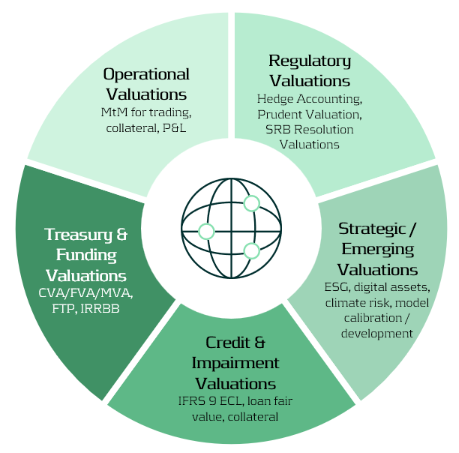
Valuation lies at the heart of financial institutions — informing decisions in trading, risk management, collateral management, accounting, and financial reporting. Yet across many banks, these valuations are performed in fragmented silos for different purposes, using different models, data sources, and systems. In addition to these core applications, valuations also support a broader range of activities, including treasury, regulatory reporting, and emerging domains such as ESG and digital assets.
As illustrated in the Valuation Map (Figure 1), we observe that in many cases different departments conduct their own valuations, often for their own distinct purposes and using distinct valuation processes. Survey evidence shows that finance and FP&A teams devote roughly 65% of their time to data gathering, cleaning, and reconciliation, leaving only about 35% for value-adding analysis1.
The Cost of Fragmentation
Fragmented valuation architectures translate directly into higher costs and operational drag. In practice, three effects are most pronounced:
- High data vendor spend – market-data pricing surveys found that some firms were paying “many multiples” more than peers for similar products and use cases, reflecting redundant sourcing and poor usage visibility2.
- Model proliferation – large banks often operate with hundreds to thousands of models across the enterprise, creating overlap in purpose and increasing governance, maintenance, and compute costs3.
- Inconsistent and time-consuming valuations – disparate models and data feeds lead to unclear ownership of valuation “truth” and significant manual reconciliation between accounting, risk, and front-office views.
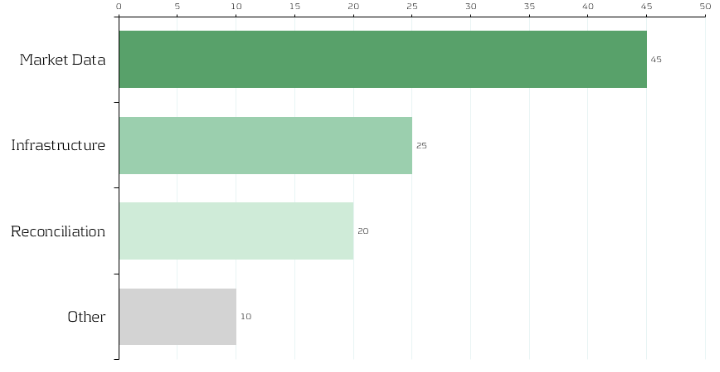
Although no public benchmark precisely mirrors our allocation, multiple industry surveys converge on the same conclusion: market data represents a dominant share of valuation costs, and fragmented reconciliation processes account for a significant portion of non-value-adding effort. Figure 2 therefore shows an indicative distribution — 45% market data, 25% infrastructure, 20% reconciliation, 10% other — to convey the relative scale of each component. Institutions will vary in mix, yet the implication is consistent: rationalizing data sourcing and automating reconciliation are among the highest-impact levers for reducing total valuation cost.
Strategic Imperative: Centralizing and Standardizing Valuation
Banks can unlock substantial efficiency gains by centralizing valuation logic and governing data flows. Similar to how treasury departments manage liquidity, banks should treat valuation processes as coordinated enterprise capabilities rather than fragmented operational activities.
Key levers include:
1-Valuation as a Service (VaaS):
Establish a centralized valuation engine providing consistent pricing APIs for all functions (risk, finance, collateral, etc.).
2-Unified Market Data Platform:
Integrate vendor feeds into a single validated golden source with standardized identifiers and governance.
3-Model Consolidation and Validation:
Maintain one approved model per product type with clear ownership and lifecycle management.
4- Process Automation:
Automate reconciliation between accounting and risk views via shared data lineage and valuation transparency.
5- Cost Transparency:
Track valuation and data usage per business unit to encourage accountability and optimization.
Together, these measures reduce duplication, accelerate reporting cycles, and improve consistency across valuation outcomes.
Building the Foundation
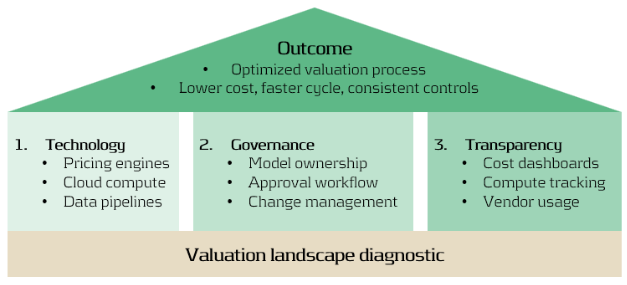
An optimized valuation operating model rests on three mutually reinforcing foundations:
- Technology: Scalable pricing engines, cloud compute elasticity, and efficient data pipelines.
- Governance: Clear model ownership, approval, and change management across risk and finance.
- Transparency: Dashboards tracking valuation cost, compute time, and data provider usage.
A practical first step: Zanders can perform a valuation landscape diagnostic, mapping all valuation types, systems, and data sources. Such analysis typically reveals 10–20% potential overlap and quick wins in data consolidation4.
Conclusion: Elevating Valuation Processes to an Enterprise Capability
In today’s environment of cost pressure and regulatory scrutiny, optimizing valuation processes is not only about efficiency—it is about strengthening consistency, transparency, and trust across the organization. Institutions that unify valuation workflows, data, and governance are better positioned to:
- Reduce operational costs and reconciliation workloads.
- Rationalize compute power – costs of running multiple models unnecessarily.
- Strengthen governance and auditability.
- Accelerate model deployment and reporting cycles.
- Enable transparent, sustainable, and data-driven decision-making.
At Zanders, we design and implement integrated valuation frameworks at leading financial institutions, that combine operational efficiency with regulatory robustness.
If your organization is looking to streamline valuation processes, harmonize market data, or reduce reconciliation workloads, we invite you to connect with our experts.
-
AI in Treasury: Automating Intercompany Loan Pricing

-
A new interest-rate risk framework for BNG bank

-
ESG-related derivatives: regulation & valuation

-
Empowering Royal FloraHolland with a new credit line to support its sustainability efforts

-
Intra-Group Loans Transfer Pricing: What’s Important in H2 2026?

-
A Roadmap for Banks to Geopolitical Risk Taxonomy

-
ECB’s 2026 Geopolitical Reverse Stress Test: Why Channels Matter More Than Numbers


Dive deeper into the strategy of compute
The Strategic Role of Compute in Modern BankingFootnotes
- FP&A Trends (2024), FP&A Trends Survey 2024 (FP&A Trends Survey 2024: Empowering Decisions with Data: How FP&A Supports Organisations in Uncertainty | FP&A Trends) ↩︎
- Substantive Research (2024), Market Data Pricing (Market Data Pricing - 2023 In Review - Edited Highlights) ↩︎
- UK Finance (2023), Prudential Regulation Authority (PRM), SS1/23 (Prudential Regulation Authority (PRA), SS1/23 - what you don’t know can hurt you | Insights | UK Finance) ↩︎
- TRG Screen (2023), Market data spend hits another record as complexity grows (WP | Market data spend hits another record as complexity grows) ↩︎